
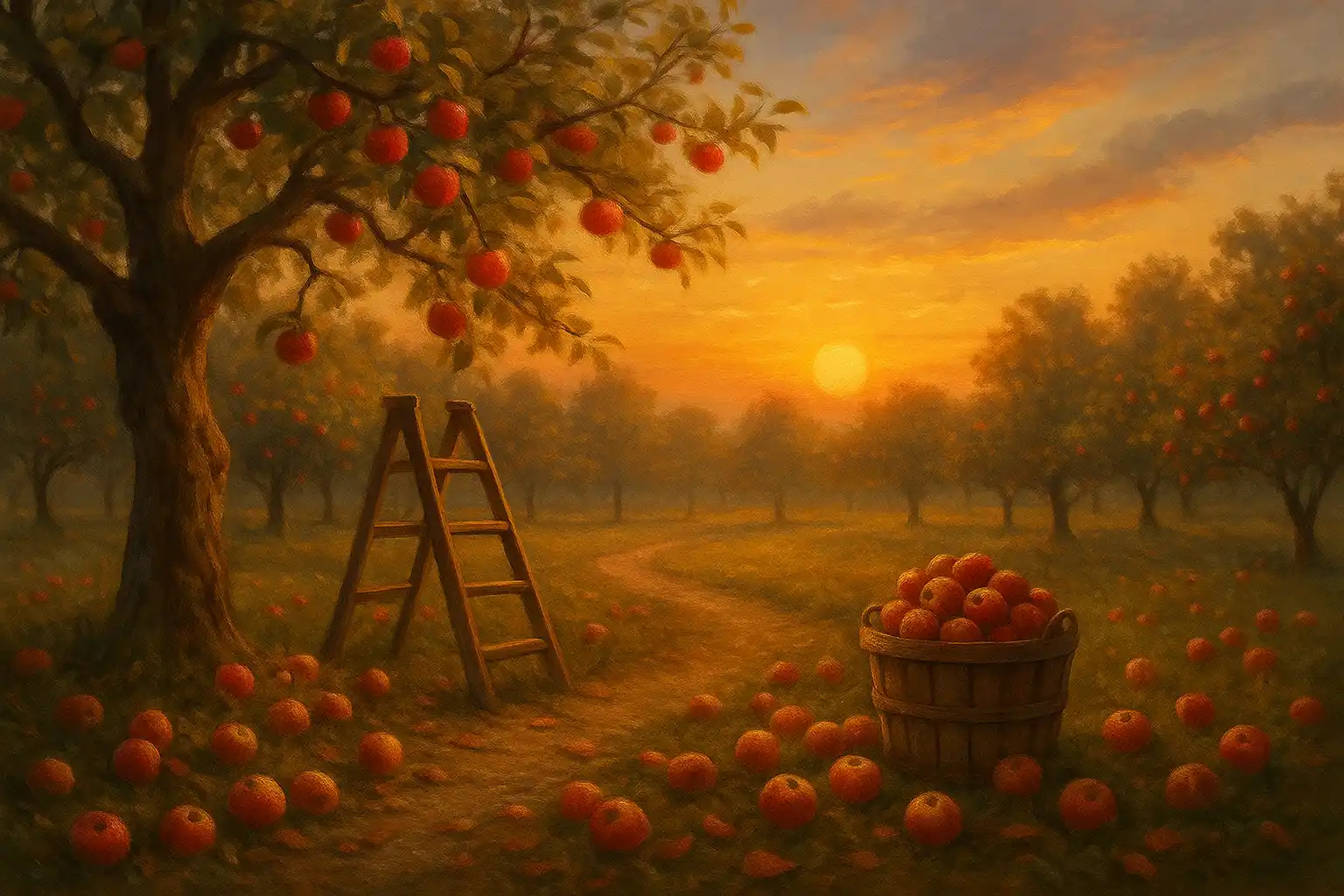
“After Apple-Picking” is one of Frost’s most unsettling poems, and that unsettling quality comes from what he doesn’t say. Published in 1914, it starts straightforward enough: tired farmer finishes harvesting apples, gets drowsy, heads toward sleep. But that sleep feels wrong somehow. Too heavy, too final. By the end you’re not sure if the speaker is just exhausted or if this is something more permanent. Death, maybe. Or at least the edge of it.
What makes the poem work is how Frost keeps everything grounded in physical details while the meaning drifts into darker territory. You can smell the apples, feel the ache in the speaker’s feet, picture the ladder leaning against the tree. But underneath all that concrete imagery is this creeping sense that the speaker might not wake up. That gap between what’s said and what’s implied is where the poem lives.
Table of Contents:
- The Verse: Reading Frost’s Meditation on Work and Sleep
- Beyond the Orchard: Decoding the "Essence of Winter Sleep"
- Perfectionism, Incompletion, and the Edge of Death: A Deeper Look
- Irregular Rhyme and Drifting Rhythm: How the Poem Mimics Drowsiness
- 1914 and the New England Farm: Turning Labor Into Metaphysics
- More Than a Farming Poem: Why Frost’s Exhaustion Resonates Today
- "Whatever Sleep It Is": The Words That Haunt the Harvest
- Daniel’s Perspective: The "Instep Arch" and the Weight of Success
- Final Thoughts: Sitting With the Uncertainty of the Long Sleep
- Explore More Frost
The Verse: Reading Frost’s Meditation on Work and Sleep
First published in 1914 in Robert Frost’s collection North of Boston. This poem is in the public domain in the United States.
After Apple-Picking by Robert Frost
My long two-pointed ladder’s sticking through a tree Toward heaven still, And there’s a barrel that I didn’t fill Beside it, and there may be two or three Apples I didn’t pick upon some bough. But I am done with apple-picking now.
Essence of winter sleep is on the night, The scent of apples: I am drowsing off. I cannot rub the strangeness from my sight I got from looking through a pane of glass I skimmed this morning from the drinking trough And held against the world of hoary grass. It melted, and I let it fall and break.
But I was well Upon my way to sleep before it fell, And I could tell What form my dreaming was about to take. Magnified apples appear and disappear, Stem end and blossom end, And every fleck of russet showing clear.
My instep arch not only keeps the ache, It keeps the pressure of a ladder-round. I feel the ladder sway as the boughs bend. And I keep hearing from the cellar bin The rumbling sound Of load on load of apples coming in.
For I have had too much Of apple-picking: I am overtired Of the great harvest I myself desired. There were ten thousand thousand fruit to touch, Cherish in hand, lift down, and not let fall. For all That struck the earth, No matter if not bruised or spiked with stubble, Went surely to the cider-apple heap As of no worth.
One can see what will trouble This sleep of mine, whatever sleep it is. Were he not gone, The woodchuck could say whether it’s like his Long sleep, as I describe its coming on, Or just some human sleep.
Beyond the Orchard: Decoding the “Essence of Winter Sleep”
Speaker’s done picking apples. Ladder’s still leaning against the tree “toward heaven,” barrel’s not quite full, few apples left on branches. But he’s finished. “I am done with apple-picking now.” That line carries weight. Not just done for the day. Done.
He’s drowsy, slipping into sleep. “Essence of winter sleep is on the night.” Winter sleep, not regular sleep. His vision is strange from looking through a sheet of ice he pulled off the water trough that morning. Held it up like glass, looked through it at the frost-covered grass, then let it melt and break. His perception’s been off all day.
Even as he drifts off, he’s still seeing apples. “Magnified apples appear and disappear.” Stem end, blossom end, every detail clear. His feet still feel the ladder rungs. He hears apples rumbling into the cellar bin. The work won’t leave his body or mind.
Then he admits something: “I have had too much / Of apple-picking: I am overtired / Of the great harvest I myself desired.” He wanted this harvest, worked for it, but now it’s too much. Ten thousand apples to handle carefully, and any that fell got tossed into the cider heap as worthless. The perfectionism exhausted him.
Final lines are where it gets dark: “One can see what will trouble / This sleep of mine, whatever sleep it is.” Whatever sleep it is. Not “tonight’s sleep” or “this rest.” Whatever sleep. Is it regular sleep after hard work? Or is it death?
He compares it to a woodchuck’s hibernation. If the woodchuck were around, it could tell him whether this sleep resembles its long winter dormancy “or just some human sleep.” But the woodchuck’s gone. Nobody can answer the question. The poem ends without resolving whether this is rest or something final.
The meaning is about exhaustion that goes beyond physical. About work that was desired but became overwhelming. About incompletion, all those unpicked apples and the unfilled barrel. And about the uncertainty of what comes after effort ends. The drowsiness feels like death approaching, but Frost never confirms it. Just lets that possibility hang there.
Perfectionism, Incompletion, and the Edge of Death: A Deeper Look
Work and Exhaustion
The physical details ground everything. Aching feet from ladder rungs. Fingers that touched ten thousand apples. The sway of branches, the rumble of fruit dropping into bins. Frost captures how work doesn’t end when you stop working. It stays in your body, repeats in your mind. The speaker can’t escape apple-picking even as he drifts toward sleep. That persistence of labor, the way it haunts you after you’re done, feels true beyond just farming.
Perfectionism and Worth
Any apple that fell went to the cider heap as worthless, even if undamaged. That standard, that need for perfection in handling each piece of fruit, adds psychological weight to physical labor. The speaker had to “cherish in hand, lift down, and not let fall” ten thousand times. That level of care is exhausting. And ultimately futile since he couldn’t pick them all anyway. The perfectionism becomes another source of weariness.
Incompletion
The barrel’s not filled. Apples remain on branches. The work is unfinished, and that bothers him even though he’s done. This reflects how life works. You never complete everything. There’s always more that could be done, should be done, wasn’t done. That sense of incompletion follows you into whatever comes next. The ladder pointing “toward heaven” suggests reaching but not arriving, effort but not completion.
Sleep as Death
This is the poem’s core ambiguity. That sleep could be ordinary rest after hard labor. Or it could be death. “Whatever sleep it is” refuses to clarify. The comparison to the woodchuck’s long sleep pushes toward death. Hibernation that might or might not include waking. “Essence of winter sleep” sounds more permanent than a nap. Frost is suggesting mortality without stating it outright, which makes it more unsettling than if he’d been explicit.
Vision and Perception
The ice pane he looked through that morning messed with his sight. That strange vision hasn’t left him. Now he sees magnified apples even with eyes closed. His perception is unreliable, blurred between waking and dreaming, reality and memory. That distorted vision mirrors the uncertainty about what’s happening to him. If you can’t trust what you see, how do you know what’s real? Is this drowsiness or death? He can’t tell, and neither can we.
Irregular Rhyme and Drifting Rhythm: How the Poem Mimics Drowsiness
The poem uses irregular rhyme and varied line lengths. Creates this drowsy, drifting quality that matches the content. Some rhymes are close together, others spaced far apart. The inconsistency makes you feel the speaker’s fatigue, the way thoughts don’t quite connect when you’re exhausted.
Lines vary from very short (“Toward heaven still”) to much longer. That variation mirrors the rhythm of drowsing, the way consciousness flickers when you’re falling asleep. Thoughts fragment, sentences trail off, then suddenly focus on a clear detail.
Enjambment throughout. Sentences flow across multiple lines, creating momentum that pulls you forward the way sleep pulls the speaker. You keep reading to complete the thought, same way he keeps drifting deeper into whatever this is.
The rhyme scheme is loose but present. Enough pattern to feel intentional, but irregular enough to feel natural rather than formal. Matches Frost’s usual approach of using form without letting it dominate content.
That shift to “whatever sleep it is” at the end changes everything retrospectively. You read the whole poem as man going to bed, then that line makes you reconsider. Maybe you just read someone dying. The uncertainty is the point. Frost structures it so you can’t know for sure.
1914 and the New England Farm: Turning Labor Into Metaphysics
Published in 1914 in North of Boston, Frost’s second collection. That book established him as someone who could take New England farm life and find deeper meanings in it. This poem fit that pattern: ordinary labor transformed into meditation on mortality.
Frost actually worked farms, knew apple harvesting. The physical details come from experience. But he’s not writing a farming manual. He’s using familiar labor as a way into questions about effort, completion, and what comes after.
1914 was pre-WWI for America, though the war had started in Europe. Context of massive death might’ve made a poem about uncertain sleep resonate differently than intended. People were already thinking about mortality, about efforts that lead nowhere, about incompletion on a massive scale.
The poem shows Frost’s range. He could do clear narratives like “Mending Wall” and ambiguous meditations like this. The uncertainty about whether this is death or sleep is intentional, not sloppy. He’s comfortable leaving major questions unresolved, trusting readers to sit with ambiguity.
Over time it’s become one of his most analyzed works precisely because of that ambiguity. Literary critics love debating whether the speaker dies at the end. Frost never clarified, which means the debate continues.
More Than a Farming Poem: Why Frost’s Exhaustion Resonates Today
It demonstrates how to write about death without saying death. The entire poem suggests mortality through imagery and tone without ever stating it directly. That indirection is more powerful than explicit statements would be. You feel the weight of something final approaching without being told what it is.
The poem captures exhaustion perfectly. Not just physical tiredness but the deeper weariness that comes from sustained effort, from caring too much about getting things right, from realizing nothing’s ever truly finished. That psychological dimension makes it more than a farming poem.
It shows Frost’s skill at blending concrete and abstract. Every detail is specific: ladder, barrel, apples, ice pane. But all of it points toward larger questions about life, work, and mortality. The physical grounds the abstract, makes philosophical questions feel real rather than academic.
From a teaching perspective, it’s perfect for discussing ambiguity, symbolism, how form mirrors content, and whether artistic uncertainty is a weakness or strength. The debate about what happens at the end never resolves, which keeps the poem alive in discussions.
The poem also validates a common human experience: being so tired you’re not sure what’s real anymore, when sleep feels like it might be more than sleep. Everyone’s felt that dissociation that comes with deep exhaustion. Frost gives that feeling literary weight.
“Whatever Sleep It Is”: The Words That Haunt the Harvest
“But I am done with apple-picking now.”
Simple statement that carries multiple meanings. Done for the day? Done for the season? Done forever? That ambiguity is the whole poem in one line.
“Essence of winter sleep is on the night”
“Winter sleep” suggests hibernation, dormancy, possibly death. Not “I’m sleepy” but something deeper and more permanent. The word choice is everything.
“For I have had too much / Of apple-picking: I am overtired / Of the great harvest I myself desired.”
The contradiction of wanting something then being destroyed by achieving it. He desired this harvest, worked for it, and now it’s killed him. Or at least exhausted him to the point of uncertainty about what comes next.
“One can see what will trouble / This sleep of mine, whatever sleep it is.”
“Whatever sleep it is” refuses to clarify. That openness is what makes the line haunting. He doesn’t know what’s happening to him. Neither do we.
“The woodchuck could say whether it’s like his / Long sleep, as I describe its coming on, / Or just some human sleep.”
Comparing his sleep to hibernation suggests it might be a long one he doesn’t wake from. But the woodchuck’s gone, so no answer comes. The question hangs unresolved.
Daniel’s Perspective: The “Instep Arch” and the Weight of Success
I’ve spent my fair share of Octobers in New England orchards, and Frost captures a sensation here that most poets miss: the physical “echo” of the ladder. When he says his “instep arch” still feels the pressure of the rung, he isn’t being poetic, he’s being literal. After ten hours on a ladder, your body keeps climbing even when you’re in bed.
To me, Daniel Abbott, this poem is actually about the exhaustion of getting exactly what you wanted. The speaker isn’t sad because he failed; he’s overwhelmed because he succeeded too much. There were “ten thousand thousand fruit to touch,” and the sheer abundance has become a burden. I think Frost is showing us that even the things we love, our “great harvests”, can leave us bruised and hollow if we don’t know when to let the rest fall to the ground. It’s a poem for anyone who has ever finished a massive project and felt, not triumph, but a desperate, bone-deep need for a sleep that “just stays.”
Final Thoughts: Sitting With the Uncertainty of the Long Sleep
“After Apple-Picking” takes the end of harvest and turns it into something darker. A tired farmer drifting toward sleep becomes a meditation on mortality, incompletion, and the uncertainty of what comes after effort ends. Frost keeps everything grounded in physical details while the meaning slips toward death without ever confirming it.
That ambiguity is the poem’s power. You’re never sure if the speaker is just exhausted or dying. The comparison to the woodchuck’s hibernation, the “essence of winter sleep,” the “whatever sleep it is,” all suggest something final without stating it outright. Frost makes you feel the weight of mortality through implication rather than declaration.
What lasts is how the poem captures a particular kind of exhaustion. The weariness that comes from wanting something, achieving it, then realizing it wasn’t worth the cost. The incompletion that haunts you even when you’re done. The way work stays in your body and mind long after you stop. And that drowsiness that feels like it might be more than just needing rest.
More than a century later, the poem still works because those experiences haven’t changed. We still push ourselves too hard, still care too much about doing things perfectly, still reach the end of something and wonder if we’re really done or just exhausted. And sometimes, at the edge of sleep, we still feel that uncertainty about whether we’ll wake up. Frost caught all of that in a poem about apples.
Explore More Frost
If you enjoyed our analysis, keep exploring Frost’s works with the following articles:
- Acquainted with the Night by Robert Frost: Analysis and Interpretation
- Reluctance by Robert Frost: Analysis and Interpretation
- The Road Not Taken by Robert Frost: Analysis and Interpretation
About the Author:
I’m Daniel Abbott and I’ve spent years reading Frost against the backdrop of the New England seasons. My goal with these articles is to move past the textbook jargon and look at the real human grit behind the verse. Thanks for reading along.