
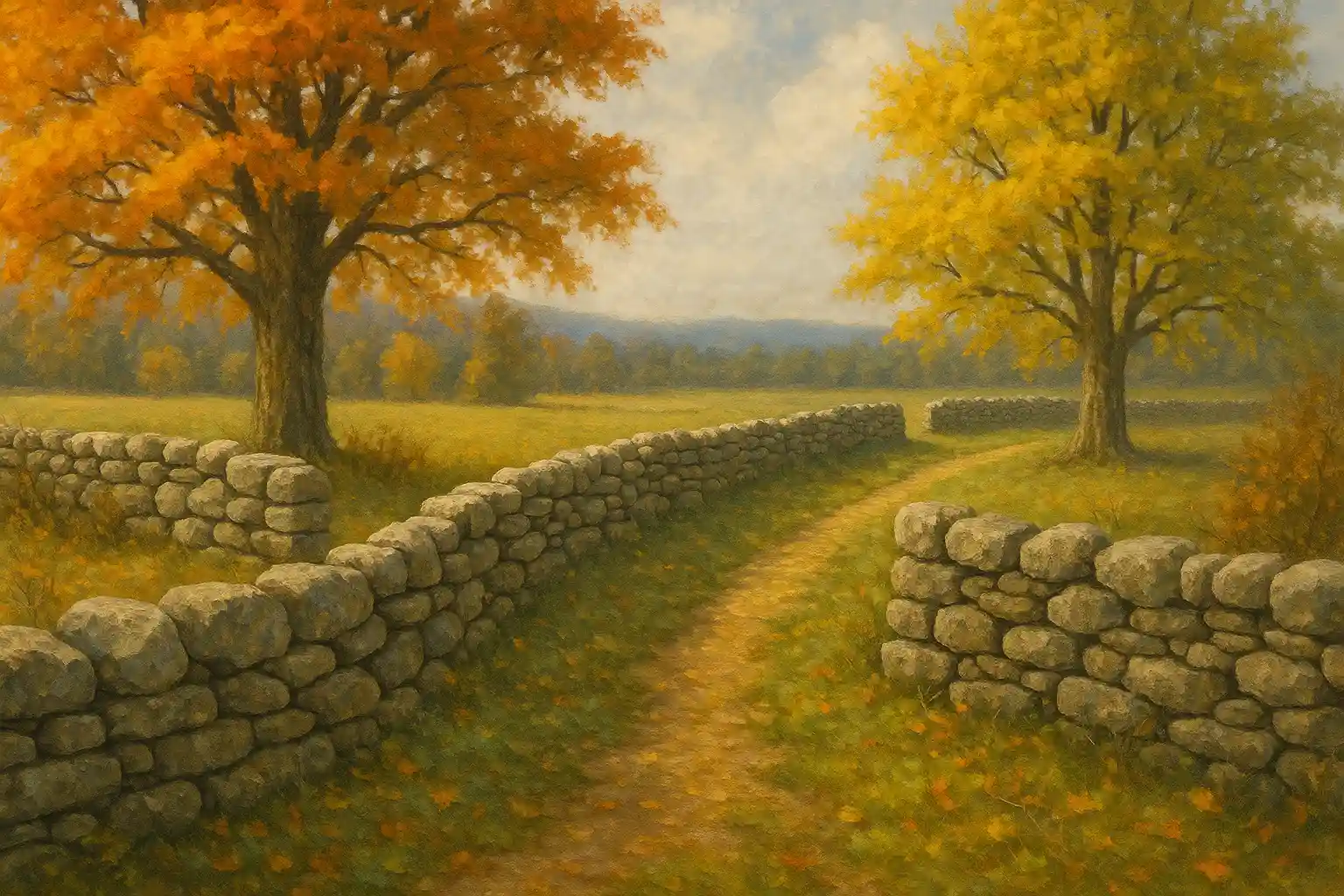
“Mending Wall” is probably Frost’s most debated poem, and that debate is exactly what he wanted. Published in 1914, it’s about two neighbors who meet every spring to repair the stone wall between their properties. One guy questions why they even need the wall. The other responds with an old saying: “Good fences make good neighbors.” That’s it. That’s the whole setup. But that simple disagreement has sparked arguments for over a century about when walls help and when they just divide.
What makes the poem work is Frost doesn’t tell you who’s right. The questioning neighbor seems more thoughtful, more open. But the traditional neighbor isn’t portrayed as stupid, just stubborn. Frost gives you both perspectives and walks away, leaving you to figure out where you stand on boundaries, tradition, and whether walls between people are necessary or just habits we can’t break.
Table of Contents:
- The Verse: Reading Frost’s Most Debated Dialogue
- Loaves and Balls of Stone: Decoding the Annual Ritual of Repair
- Tradition, Boundaries, and the "Something" That Hates a Wall: A Deeper Look
- Blank Verse and Mischievous Metaphor: Analyzing Frost’s Narrative Style
- 1914 and the Origins of a 100-Year-Old Argument
- Beyond Property Lines: How "Good Fences" Became Cultural Currency
- "Good Fences" and "Old-Stone Savages": The Words That Define the Conflict
- Daniel’s Perspective: The Ritual of the "Loaves and Balls"
- Final Thoughts: Choosing Between the Wall and the Neighbor
- Explore More Frost
The Verse: Reading Frost’s Most Debated Dialogue
First published in 1914 in Robert Frost’s collection North of Boston. This poem is in the public domain in the United States.
Mending Wall by Robert Frost
Something there is that doesn’t love a wall, That sends the frozen-ground-swell under it, And spills the upper boulders in the sun; And makes gaps even two can pass abreast.
The work of hunters is another thing: I have come after them and made repair Where they have left not one stone on a stone, But they would have the rabbit out of hiding, To please the yelping dogs. The gaps I mean, No one has seen them made or heard them made, But at spring mending-time we find them there.
I let my neighbour know beyond the hill; And on a day we meet to walk the line And set the wall between us once again. We keep the wall between us as we go. To each the boulders that have fallen to each. And some are loaves and some so nearly balls We have to use a spell to make them balance: “Stay where you are until our backs are turned!”
We wear our fingers rough with handling them. Oh, just another kind of out-door game, One on a side. It comes to little more: There where it is we do not need the wall: He is all pine and I am apple orchard. My apple trees will never get across And eat the cones under his pines, I tell him. He only says, “Good fences make good neighbours.”
Spring is the mischief in me, and I wonder If I could put a notion in his head: “Why do they make good neighbours? Isn’t it Where there are cows? But here there are no cows. Before I built a wall I’d ask to know What I was walling in or walling out, And to whom I was like to give offence.
Something there is that doesn’t love a wall, That wants it down.” I could say “Elves” to him, But it’s not elves exactly, and I’d rather He said it for himself. I see him there Bringing a stone grasped firmly by the top In each hand, like an old-stone savage armed. He moves in darkness as it seems to me, Not of woods only and the shade of trees. He will not go behind his father’s saying, And he likes having thought of it so well He says again, “Good fences make good neighbours.”
Loaves and Balls of Stone: Decoding the Annual Ritual of Repair
Poem opens: “Something there is that doesn’t love a wall.” Nature works against walls. Ground freezes and swells, pushing stones loose. Hunters knock down sections chasing rabbits. Every spring, gaps appear that nobody saw being made. The world itself seems to tear the wall down.
So every spring, the speaker contacts his neighbor and they meet to fix it. They walk the property line together, each handling the stones on their side. Some stones are loaves, others nearly round. Hard work, fingers get roughed up, but the speaker calls it “just another kind of out-door game.”
Then he questions it. His side is apple orchard, the neighbor’s is pine trees. “My apple trees will never get across / And eat the cones under his pines.” No livestock to contain, no practical reason for the barrier. He tells the neighbor this. The response? “Good fences make good neighbors.”
That saying bugs him. “Why do they make good neighbors? Isn’t it / Where there are cows?” Maybe walls made sense on farms with animals, but here? He’d want to know what he’s walling in or out before building one. But he doesn’t say this out loud. Just thinks it.
Instead he repeats: “Something there is that doesn’t love a wall, / That wants it down.” He considers saying “Elves” to his neighbor, making it whimsical, but decides against it. He’d rather the neighbor figure it out himself.
What he sees is a neighbor who won’t question tradition. The guy carries stones “like an old-stone savage armed,” moving in darkness that’s not just literal shade. He’s trapped by his father’s saying, clinging to it without examining whether it makes sense. And he repeats it again: “Good fences make good neighbors.”
The meaning sits in that unresolved tension. One person questioning, one defending tradition. The wall gets rebuilt despite the speaker’s doubts. Frost isn’t telling you walls are bad or good. He’s showing two mindsets and letting you decide.
Tradition, Boundaries, and the “Something” That Hates a Wall: A Deeper Look
Boundaries and Their Purpose
The wall divides property but also represents all the ways people separate themselves. Social boundaries, emotional walls, barriers we maintain without thinking why. The speaker wants to know the purpose before building a wall. What are you keeping in or out, and who benefits? Those questions apply way beyond property lines.
Tradition Versus Questioning
The neighbor repeats what his father told him. That’s enough for him. The speaker represents the opposite: question everything, especially if it seems pointless. This tension between accepting inherited wisdom and demanding reasons shows up everywhere. Frost puts both views in the poem and doesn’t pick sides.
Nature Resists Division
“Something there is that doesn’t love a wall.” That line suggests nature itself pushes back against human attempts to divide things. Frost breaks stones loose, gaps appear mysteriously. Maybe the world tends toward openness and walls are humans fighting that natural tendency. The fact that the wall needs constant repair suggests maintaining divisions requires ongoing effort against natural forces.
Communication and Connection
Ironic that rebuilding the wall is what brings these neighbors together each spring. They cooperate to maintain what separates them. The speaker calls it a game, one person on each side. Maybe that’s part of what “good fences make good neighbors” means: maintaining boundaries creates opportunities for connection.
Darkness and Enlightenment
The neighbor moves “in darkness as it seems to me, / Not of woods only and the shade of trees.” That darkness is intellectual. The neighbor won’t examine his beliefs, won’t go “behind his father’s saying.” He’s described as “an old-stone savage,” primitive in his adherence to tradition. The speaker, by contrast, is full of spring mischief. One represents stagnation, the other growth. Or one represents stability, the other chaos. Depends how you read it.
Blank Verse and Mischievous Metaphor: Analyzing Frost’s Narrative Style
The poem is blank verse, unrhymed iambic pentameter. That formal structure creates the steady rhythm of lifting and placing stones, but Frost varies it enough to sound conversational.
Lots of enjambment, sentences flowing across line breaks. When the neighbor says his line, though, Frost gives it space: “Good fences make good neighbours.” Stand-alone statement that gets emphasis through placement.
The poem circles back to its opening line later: “Something there is that doesn’t love a wall, / That wants it down.” That repetition frames the piece with resistance to walls, emphasizing the idea won’t go away.
The speaker’s voice is playful, almost mischievous. Calling it a game, imagining elves, considering how to challenge his neighbor. But he never actually confronts him directly. Just thinks these things while they work. He questions the wall but helps rebuild it anyway.
1914 and the Origins of a 100-Year-Old Argument
Published in 1914 in North of Boston, Frost’s second collection. That book established him as a major American voice. This poem became famous quickly, partly because “Good fences make good neighbors” was so quotable.
Frost wrote it after returning to New England from England. He’d actually mended walls with his neighbor in New Hampshire, so the scene came from real experience. But he was using that annual ritual to explore bigger questions about boundaries and tradition.
The timing matters. 1914 was right before WWI exploded. Europe was about to tear itself apart over borders. A poem questioning whether walls are necessary might’ve resonated differently as that conflict developed, though Frost wasn’t explicitly commenting on geopolitics.
The phrase “Good fences make good neighbors” entered common speech. People quote it who’ve never read the poem, usually to justify boundaries. What’s funny is in the poem it’s not Frost’s position, it’s the neighbor’s. Frost is questioning it. But the phrase took on a life of its own.
Beyond Property Lines: How “Good Fences” Became Cultural Currency
It’s one of the most accessible Frost poems for exploring complex ideas. The scenario is simple but the implications sprawl. When are boundaries helpful? When are they just habits? The poem raises these questions without preaching answers.
The “Good fences make good neighbors” phrase has become cultural currency. It’s been used to justify everything from property rights to immigration restrictions. That one line has probably been quoted more than any other Frost wrote, though often by people who don’t realize it’s being questioned in the poem itself.
It demonstrates Frost’s skill at creating productive ambiguity. You can read this as pro-wall or anti-wall depending on which character you identify with. Both readings are valid.
From a teaching perspective, it’s perfect for discussing symbol, metaphor, dialogue, and characterization through action.
The poem captures something permanent: we’re torn between connection and separation, between questioning and accepting, between tearing down walls and building them up. That tension won’t resolve, which means the poem stays relevant.
“Good Fences” and “Old-Stone Savages”: The Words That Define the Conflict
“Something there is that doesn’t love a wall”
Opening line that sets up everything. Immediately you know nature resists human divisions. That “something” is deliberately vague. Could be frost, could be hunters, could be a metaphysical force pushing toward openness. The inversion (“something there is” instead of “there is something”) makes it sound mysterious, almost mystical.
“Good fences make good neighbours.”
Most famous line from the poem, repeated twice. Outside context, it sounds like wisdom. Inside the poem, it’s being questioned. The neighbor clings to it without examining whether it’s true in this situation. That gap between how it’s quoted in culture versus how it functions in the poem is fascinating.
“My apple trees will never get across / And eat the cones under his pines”
The speaker’s humor showing through. Obviously trees don’t invade each other’s territory. He’s pointing out how absurd the wall is in their specific case. The joke underlines his argument: this wall serves no practical purpose.
“He moves in darkness as it seems to me, / Not of woods only and the shade of trees.”
The darkness is intellectual, not physical. The neighbor won’t examine his beliefs. He’s trapped by tradition, moving in the darkness of unexamined assumptions. Pretty harsh characterization from the speaker, comparing him to a savage wielding stones.
“Before I built a wall I’d ask to know / What I was walling in or walling out”
This captures the speaker’s whole philosophy. Question before building, understand purpose before committing to division. It’s a reasonable approach to boundaries: know what you’re doing and why. But he never says this out loud to his neighbor, just thinks it.
Daniel’s Perspective: The Ritual of the “Loaves and Balls”
Every time I read Mending Wall, I’m less interested in the politics of the wall and more struck by the sheer, annoying physical labor of it. If you’ve ever actually tried to stack New England fieldstone, those “loaves and balls” Frost mentions, you know they don’t want to stay put. They are heavy, they are cold, and the frost-heave is constantly trying to spit them back out of the ground.
To me, Daniel Abbott, the neighbor isn’t a “villain” for wanting the wall; he’s a man addicted to a tradition he can’t explain. But the speaker is just as guilty! He’s the one who calls his neighbor to start the repair. I think Frost is showing us that the “walling in” isn’t what matters, it’s the reason to meet. Without that wall to fix every spring, these two men would never speak at all. It’s a poem about the strange, difficult rituals we use to keep from being completely alone. Sometimes, we build a barrier just so we have something to talk over.
Final Thoughts: Choosing Between the Wall and the Neighbor
“Mending Wall” has lasted because it presents a debate without resolving it. Every spring these neighbors meet to repair what nature keeps trying to tear down. One questions why they bother, the other repeats an old saying. The wall gets rebuilt regardless. That’s how it goes with walls, physical or metaphorical. Some people see them as necessary structures that prevent conflict. Others see them as arbitrary divisions that prevent connection.
Frost gives us both perspectives without declaring a winner. The questioning neighbor seems more enlightened, sure, but maybe there’s wisdom in the traditional neighbor’s approach too. Maybe good fences really do make good neighbors, even if we can’t articulate why. Or maybe they’re just habits we can’t break, stones we keep stacking because that’s what our fathers did.
The genius is Frost knows the answer doesn’t matter as much as the question. The poem isn’t solving the problem of boundaries. It’s making you think about your own walls, why you maintain them, whether they serve you or just separate you from people you might actually connect with. More than a century after publication, we’re still having that debate. The wall still stands, still needs repair, and we’re still deciding whether that’s a good thing.
Explore More Frost
If you enjoyed our analysis, keep exploring Frost’s works with the following articles:
- After Apple-Picking by Robert Frost: Analysis and Interpretation
- Acquainted with the Night by Robert Frost: Analysis and Interpretation
- Reluctance by Robert Frost: Analysis and Interpretation
About the Author:
I’m Daniel Abbott and I’ve spent years reading Frost against the backdrop of the New England seasons. My goal with these articles is to move past the textbook jargon and look at the real human grit behind the verse. Thanks for reading along.