
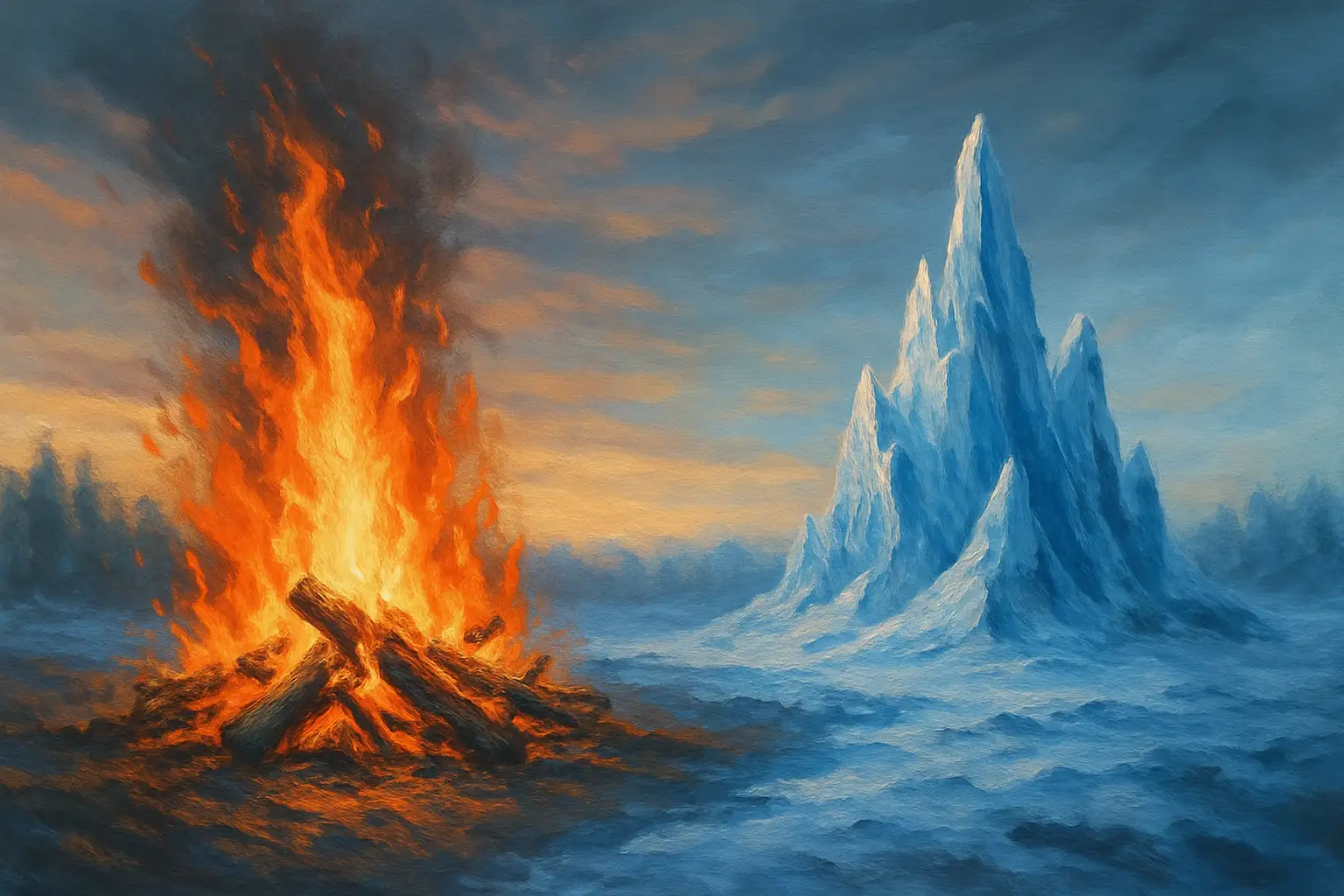
“Fire and Ice” is nine lines that pack more punch than most poems ten times its length. First published in 1920, it’s become one of Frost’s most quoted pieces despite being short enough to fit on a napkin. The setup is deceptively simple: how will the world end, in fire or ice? But Frost isn’t really talking about apocalypse. He’s talking about desire and hate, passion and indifference, the emotions that destroy us long before any cosmic event could.
What makes it work is how casual Frost sounds. He’s discussing the end of everything like he’s chatting about the weather. That understated tone is what makes the poem unsettling. By the time you hit those final words “And would suffice,” you realize he’s been talking about something much darker than he let on. Nine lines, two options, both of them tied directly to human nature.
Table of Contents:
- The Verse: Nine Lines of Destructive Power
- Choosing the End: Decoding the Emotions Behind the Elements
- Burning Passion and Frozen Hate: A Deeper Look at Human Nature
- The Asymmetric Rhythm of Destruction
- 1920, Dante, and the Scientific Debate on how the World Ends
- Napkin-Sized Mastery: Why This Short Poem Became a Cultural Landmark
- "And Would Suffice": The Words That Land Like a Punch
- Daniel’s Perspective: The Chilling "Suffice"
- Final Thoughts: The Destruction We Carry Inside
- Explore More Frost
The Verse: Nine Lines of Destructive Power
First published in 1920 in Harper’s Magazine and later included in Robert Frost’s 1923 collection New Hampshire. This poem is in the public domain in the United States.
Fire and Ice by Robert Frost
Some say the world will end in fire, Some say in ice. From what I’ve tasted of desire I hold with those who favor fire.
But if it had to perish twice, I think I know enough of hate To say that for destruction ice Is also great And would suffice.
Choosing the End: Decoding the Emotions Behind the Elements
Poem opens with people debating how the world will end. Fire or ice, take your pick. Frost jumps in with his own take: based on what he knows about desire, he’s team fire. Desire burns, consumes, destroys. Makes sense.
Then he shifts. If the world could end twice, he’d put money on ice for round two. Why? Because he knows hate. And hate is cold, freezing, suffocating. Ice would work just fine for destruction too. “And would suffice” is such a casual way to say “yeah, that’d kill everything.”
The fire and ice aren’t just literal. Fire represents desire in all its forms: passion, lust, greed, ambition, that burning want that makes people do reckless things. Ice represents hate, indifference, coldness, the slow freeze of not caring or actively wishing harm. Both emotions destroy, just in different ways.
What’s clever is Frost has experienced both. “From what I’ve tasted” and “I think I know enough” suggest he’s not theorizing. He’s speaking from personal knowledge of how destructive these feelings can be. The poem becomes less about cosmic apocalypse and more about emotional apocalypse, the way desire and hate wreck lives and relationships.
The tone is almost conversational, like he’s considering the options without much stress. That casualness makes it more disturbing. He’s not warning against these emotions or preaching about their dangers. He’s just acknowledging yeah, either one could do it. Either one would be enough.
By the end, you realize the world ending is almost beside the point. Frost is talking about how we destroy each other, and ourselves, every day through these same forces. The apocalypse is already here, playing out in human interactions. Fire and ice aren’t future threats. They’re present realities.
Burning Passion and Frozen Hate: A Deeper Look at Human Nature
Desire as Fire
Frost sides with fire because of desire, and he’s not just talking about romantic passion. Desire covers everything we burn for: love, power, money, success, pleasure. That wanting can consume everything in its path. Burns hot, burns fast, leaves ash. We’ve all seen it or felt it, that intensity that makes rational thought impossible. Fire destroys by overwhelming, by burning too bright and too hot until there’s nothing left.
Hate as Ice
Ice is hate, but also indifference, which might be worse. Fire at least burns with passion, even if destructive. Ice is cold calculation, spite, or just not caring at all. The slow freeze of relationships ending, of societies turning on each other, of people choosing cruelty or apathy. Ice doesn’t destroy quickly. It preserves things in death, frozen and lifeless. That makes it creepier somehow.
Both Are Enough
The poem’s punch line is “would suffice.” Not “might work” or “could possibly.” Would suffice. Guaranteed. Either emotion alone is powerful enough to end everything. Frost has experienced both, knows them intimately, and can confirm they’re equally destructive. That certainty is what makes the poem dark. There’s no hope for balance or moderation here. Just acknowledgment that humans carry their own destruction inside them.
Casual Apocalypse
The conversational tone is everything. Frost discusses the end of the world like he’s choosing between coffee and tea. That matter-of-fact delivery makes it more unsettling than if he’d been dramatic about it. The understatement implies this destruction is inevitable, ordinary even. Of course desire and hate destroy. Of course the world will end. No big deal. That casual acceptance is chilling.
Personal Experience
“From what I’ve tasted” and “I think I know enough” root the poem in personal experience. This isn’t abstract philosophy. Frost has felt desire’s fire and hate’s ice. He’s speaking from lived knowledge. That makes the poem more credible and more troubling. He’s not imagining how these emotions work. He knows.
The Asymmetric Rhythm of Destruction
Nine lines split into two stanzas, though some versions print it without the break. First stanza is four lines, second is five. The asymmetry fits the content since he’s weighing two options that don’t balance neatly.
Rhyme scheme is ABAABCBCB. Fire/ice/desire/fire, then twice/hate/ice/great/suffice. The rhymes come quickly because the lines are short. Some are just two syllables. “Some say in ice.” Bam, done. The brevity mirrors the poem’s theme of destruction happening fast or slow but definitely happening.
Meter is loose, mostly iambic with variations. “Some SAY the WORLD will END in FIRE.” It’s got rhythm but doesn’t feel rigid. Frost keeps it conversational, which matches the casual tone. If this were written in perfect iambic tetrameter it’d feel too formal for the chatty voice he’s using.
The short lines and quick rhymes create momentum. You move through the poem fast, which is appropriate since fire destroys quickly. But then you hit “And would suffice” and the understatement makes you stop and think. The brevity of the whole thing mirrors how quickly things can end once destructive emotions take over.
Interesting that he uses “I” twice. “I hold with those” and “I think I know.” The poem is personal opinion presented as casual observation. Not arguing, just stating what he’s learned from experience. That first-person voice makes it feel more intimate, like he’s sharing a dark realization rather than lecturing.
1920, Dante, and the Scientific Debate on how the World Ends
Frost published this in Harper’s Magazine in 1920, then included it in his 1923 Pulitzer-winning collection New Hampshire. The early 1920s were post-WWI, and people had just watched industrial-scale destruction fueled by nationalism and hate. The apocalyptic imagery would’ve hit different right after a war that killed millions.
Some scholars point to scientific debates happening then about how Earth might end. Astronomers discussed the sun expanding and burning everything, or the planet freezing as the sun died. Frost was aware of these theories, but clearly he was more interested in the emotional and psychological angles than the scientific ones.
The poem’s also been read in context of Dante’s Inferno, where the lowest circle of Hell is frozen, reserved for traitors. Fire for passion sins, ice for cold betrayal. Frost knew his Dante, so the connection isn’t accidental. He’s pulling from literary tradition while making something completely his own.
What’s striking is how modern the poem still feels. Written over a century ago, but the observation that desire and hate destroy us hasn’t aged a day. We’re still burning with want and freezing with spite. The emotions haven’t changed. Neither has their destructive power.
The poem became popular quickly and stayed that way. Gets taught in schools, quoted in other works, referenced in popular culture. Nine lines became one of the most recognizable pieces in American poetry. That kind of staying power usually means the poem tapped into something permanent about human nature.
Napkin-Sized Mastery: Why This Short Poem Became a Cultural Landmark
It’s a perfect example of compression. Frost took huge themes (like apocalypse, human emotion, destruction, mortality, etc.) and fit them into nine lines that anyone can understand. That’s incredibly hard to do. Most poets need pages to explore these ideas. Frost needed one napkin’s worth of space.
The poem demonstrates how powerful plain language can be. No fancy vocabulary, no complex metaphors beyond fire and ice. Just straightforward statements about desire and hate. The simplicity makes it accessible while the implications make it deep. You don’t need a literature degree to get it, but having one reveals more layers.
It’s become a cultural reference point. “Fire and ice” as shorthand for opposing destructive forces entered the language. People use it without necessarily knowing they’re quoting Frost. That’s rare, when a poem becomes so embedded in culture that it stops being poetry and becomes just how people talk about things.
From a teaching perspective, it’s ideal. Short enough to read in a minute, deep enough to discuss for an hour. You can use it to talk about symbolism, tone, rhyme, meter, theme, basically any poetic concept. Students can memorize it easily, which means they carry it with them. Not many poems get that kind of mental real estate.
The poem also shows Frost’s range. He’s famous for longer narrative pieces and pastoral scenes, but here he’s doing something compressed and almost epigrammatic. Proves he could work in any form, any length, and still say something meaningful.
“And Would Suffice”: The Words That Land Like a Punch
“Some say the world will end in fire, / Some say in ice.”
Opening hook that sets up the entire debate. Two options, both destructive, presented neutrally. The simplicity is deceptive. You think it’s going to be a straightforward comparison, then Frost makes it personal and psychological.
“From what I’ve tasted of desire”
The word “tasted” is perfect. Not “experienced” or “felt” but tasted, like desire is something physical he consumed. Implies both pleasure and danger, like tasting something that might be poison. Personal admission that makes the abstract concrete.
“And would suffice.”
Final three words that land like a punch. After building tension about which force is more destructive, Frost just shrugs and says ice would be enough. The understatement makes it more powerful than if he’d gone dramatic. That casual certainty is what people remember and quote.
Daniel’s Perspective: The Chilling “Suffice”
Most people read Fire and Ice as a grand, biblical prophecy, but when I sit with these nine lines, I’m always struck by how conversational, almost chatty, it feels. Frost isn’t shouting from a mountaintop; he’s weighing two terrible options like he’s choosing between two types of fencing wire.
To me, Daniel Abbott, the real “shiver” in this poem isn’t the fire of passion; it’s the word “suffice” at the very end. It is such a polite, understated word for the end of everything. It tells me that Frost saw “Ice” (hate) not as a loud, crashing force, but as a quiet, cold indifference that just… works. Having seen how long a New England winter can linger, I know that ice doesn’t need to be dramatic to be destructive; it just needs to stay cold. This poem reminds me that while “Fire” gets all the headlines, it’s the quiet, icy bitterness that usually finishes the job.
Final Thoughts: The Destruction We Carry Inside
“Fire and Ice” proves you don’t need length to create impact. Nine lines, conversational tone, two basic metaphors, yet it’s remained one of Frost’s most famous works for over a century. The poem works because it connects cosmic questions to everyday emotions everyone understands. Desire and hate aren’t abstract forces. They’re things we feel regularly, and Frost is reminding us how destructive those feelings can be.
What makes it last is the honesty. Frost isn’t preaching or warning. He’s just noting from personal experience that yeah, these emotions are powerful enough to end everything. The casual delivery makes it more disturbing than dramatics would. There’s no hope offered, no solution proposed. Just acknowledgment that we carry our own destruction inside us, and either fire or ice would do the job fine.
The poem also benefits from ambiguity. Is he talking about literal apocalypse or metaphorical? Both probably. Is it pessimistic or just realistic? Depends on your mood when you read it. That openness lets readers find their own meanings while the basic structure stays clear. Not many poems pull that off, being simultaneously simple and complex, brief and weighty, casual and deeply unsettling. That’s why people still quote those opening lines, still remember that final “would suffice,” still think about fire and ice when considering how things end.
Explore More Frost
If you enjoyed our analysis, keep exploring Frost’s works with the following articles:
- Out, Out— by Robert Frost: Analysis and Interpretation
- Birches by Robert Frost: Analysis and Interpretation
- Mending Wall by Robert Frost: Analysis and Interpretation
About the Author:
I’m Daniel Abbott and I’ve spent years reading Frost against the backdrop of the New England seasons. My goal with these articles is to move past the textbook jargon and look at the real human grit behind the verse. Thanks for reading along.